 Welding of Welders All about Welding and Welders
E7024 Welding Electrode: Complete Technical Guide
The E7024 welding electrode is a high-deposition, iron-powder, low-hydrogen-type electrode widely used in Shielded Metal Arc Welding (SMAW) for flat and horizontal fillet welds. It is designed for productivity rather than positional versatility, making it a preferred choice in fabrication environments where speed, smooth bead appearance, and high deposition rates are critical.
In practical terms, E7024 behaves like a “production electrode.” Where other electrodes emphasize control or all-position usability, E7024 focuses on laying down a lot of weld metal quickly and efficiently, particularly on thicker sections of carbon steel.
AWS Classification and Meaning of E7024
Breakdown of the AWS E7024 Designation
The classification E7024 follows the AWS A5.1 standard for carbon steel electrodes. Each digit conveys specific technical information.

Tensile Strength Rating
“70” indicates a minimum tensile strength of 70,000 psi (≈ 483 MPa).
This makes E7024 suitable for most structural and fabrication-grade carbon steels.
Welding Position Capability
“2” means the electrode is designed for flat position and horizontal fillet welds only.
This restriction exists because of its heavy iron-powder flux, which produces a fluid weld pool.
Flux Coating and Current Type
“4” signifies a rutile-based, iron powder flux coating.
It also indicates compatibility with AC and DC (DCEP) welding currents.
Chemical Composition of E7024 Electrode
Core Wire Composition
The core wire of E7024 is generally a low-carbon steel, engineered to deliver good ductility and strength without excessive hardness. Typical elements include:
Carbon (C): Low to moderate
Manganese (Mn): Improves strength and deoxidation
Silicon (Si): Enhances weld pool cleanliness
Flux Coating Constituents
The flux coating is where E7024 truly distinguishes itself. It contains:
High iron powder content (30–50%)
Rutile (titanium dioxide)
Deoxidizers and arc stabilizers
Mechanical Properties of E7024 Weld Metal
Tensile Strength
Minimum: 70,000 psi
This meets the requirements for most structural steel applications.
Yield Strength
Typically around 58,000–62,000 psi
This provides adequate resistance to plastic deformation under load.
Elongation and Impact Properties
Elongation: 22–28%
Impact toughness: Moderate, but not intended for low-temperature or critical impact applications
E7024 is strong and ductile but not designed for pressure vessels or dynamic loading environments.
Flux Coating Characteristics of E7024
Iron Powder High Deposition Flux
The defining feature of E7024 is its iron powder flux coating, which dramatically increases weld metal deposition.
Role of Iron Powder in Deposition Rate
Iron powder melts into the weld pool, allowing:
Higher travel speeds
Thicker weld beads
Fewer passes required
Welding Positions and Usability
Flat Position Welding
E7024 excels in flat (1G / 1F) welding. The fluid slag spreads evenly, producing a wide, flat bead with excellent appearance.
Horizontal Fillet Welding
It also performs well in horizontal fillet (2F) welds, especially for long, continuous joints.
However, it is not suitable for vertical or overhead welding, as the molten slag becomes difficult to control.
Polarity and Power Source Compatibility
AC Welding Capability
E7024 runs exceptionally well on AC power, making it ideal for older transformer-type welding machines.
DC Electrode Positive (DCEP)
It also performs efficiently on DC+, providing:
Stable arc
Smooth metal transfer
Reduced spatter
Advantages & Disadvantages of E7024
Advantages
Extremely high deposition rate
Smooth, wide bead profile
Easy slag removal
Minimal spatter
Excellent for long welds
Reduced operator fatigue due to drag-type technique
Disadvantages
Despite its strengths, E7024 has limitations:
Restricted to flat and horizontal positions
Not suitable for root passes
Lower impact toughness than low-hydrogen electrodes
Not recommended for critical or cyclic load applications
Typical Applications of E7024 Electrode
Structural Steel Fabrication
Used for beams, plates, and frames where high productivity is required.
Shipbuilding and Heavy Fabrication
Ideal for long fillet welds on decks, stiffeners, and bulkheads.
Repair and Maintenance Work
Common in workshops for fast buildup and surface welding on carbon steel.
Recommended Welding Parameters
Amperage Range by Electrode Size
| Electrode Size | Current Range (A) |
|---|---|
| 3.2 mm (1/8”) | 140–190 A |
| 4.0 mm (5/32”) | 180–260 A |
| 5.0 mm (3/16”) | 240–320 A |
Travel Speed and Arc Length
Use a short arc
Maintain steady travel speed
Employ a slight drag angle (5–15°)
Storage, Handling, and Moisture Control
E7024 is less moisture-sensitive than low-hydrogen electrodes, but proper storage is still important:
Keep in dry conditions
Avoid prolonged exposure to humidity
No baking usually required unless specified by manufacturer
Comparison with Other E70XX Electrodes
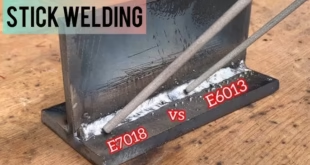
E7024 vs E7018
E7024: Higher deposition, limited positions
E7018: Low hydrogen, all positions, higher toughness
E7024 vs E6013
E7024: Stronger, heavier deposition
E6013: Easier arc start, better for thin materials
E7024 vs E7014
Both are iron powder electrodes
E7024 has higher iron content and deposition rate
E7024 vs E7014 vs E7018
| Feature | E7024 | E7014 | E7018 |
|---|---|---|---|
| Tensile Strength | 70,000 psi | 70,000 psi | 70,000 psi |
| Flux Type | Rutile + High Iron Powder | Rutile + Iron Powder | Low Hydrogen |
| Welding Positions | Flat, Horizontal | Flat, Horizontal, Vertical | All Positions |
| Deposition Rate | ⭐⭐⭐⭐⭐ (Very High) | ⭐⭐⭐⭐ (High) | ⭐⭐ (Moderate) |
| Slag Removal | Very Easy | Easy | Moderate |
| Moisture Sensitivity | Low | Low | Very High |
| Typical Skill Level | Beginner–Intermediate | Beginner | Intermediate–Advanced |